I needed to disable self sign-ups because I’ve been getting too many spam-type accounts. Thanks.
lil chick's log

Quote from lil chick on January 8, 2020, 8:27 amReplacing egg-white omelets with one egg a day didn't lead to anything good. I'm dropping egg whites because I wonder if they are upsetting the B vities.
Probably going to change my raw-milk-in-my-coffee thing as well to see if that is why my lips are still peeling.
Is it a thing that people get more serious at 8 months?
Replacing egg-white omelets with one egg a day didn't lead to anything good. I'm dropping egg whites because I wonder if they are upsetting the B vities.
Probably going to change my raw-milk-in-my-coffee thing as well to see if that is why my lips are still peeling.
Is it a thing that people get more serious at 8 months?

Quote from tim on January 9, 2020, 12:25 amThe liver downgrades VA excretion when we go really low VA and goes into conservation mode. The body needs other micronutrients to process VA. I think many VA toxicity symptoms are also other nutrient deficiency symptoms. I'm thinking the optimal VA detox formula is getting some VA from eggs, chicken, fish and herbs and getting a nutrient dense diet in every other regard. In particular having a focus on thiamine and riboflavin. Beans are the best source of thiamine and beef, yoghurt, mushrooms and squid are some of the best sources of riboflavin. Beans also supply folate and molybdenum.
The liver downgrades VA excretion when we go really low VA and goes into conservation mode. The body needs other micronutrients to process VA. I think many VA toxicity symptoms are also other nutrient deficiency symptoms. I'm thinking the optimal VA detox formula is getting some VA from eggs, chicken, fish and herbs and getting a nutrient dense diet in every other regard. In particular having a focus on thiamine and riboflavin. Beans are the best source of thiamine and beef, yoghurt, mushrooms and squid are some of the best sources of riboflavin. Beans also supply folate and molybdenum.

Quote from Jenny on January 9, 2020, 5:09 amDon’t want to go too high on oxalates with the beans though. All foods are good & bad.
Don’t want to go too high on oxalates with the beans though. All foods are good & bad.

Quote from hillcountry on January 9, 2020, 5:27 am@Tim – “I think many VA toxicity symptoms are also other nutrient deficiency symptoms.”
From what I’ve read and experienced I agree that’s the case. Beyond the vitamin-mineral side of things, I keep thinking about the cell membrane and how it is such an intelligent part of the equation of life. Since we’re replacing huge numbers of cells as we heal from toxicity it makes sense to study their constituent parts and how best to supply those. That entails drilling-down into the EFA-PUFA subject, which is quite the rabbit-hole for me, especially on how it intersects with VA-detox.
The graph at the end of this engaging lecture (@ 26:36) is a very useful visual-representation of the constituents of plant-derived oils and why we’d best avoid most of them, but perhaps not all. I’d love to know how this doctor is achieving the improvements in RBC membrane-status. The fact that he’s even testing for it puts him in elite-doc status and what he has to say about cholesterol in general and high LDL numbers in particular is alone worth the time to watch it. I had no idea there were multiple types of LDL, of which a few are not a problem, which makes standard-interpretation of LDL crude at best.
https://www.youtube.com/watch?v=NUY_SDhxf4k
I’ve been pretty much winging-it on fats and oils ever since reading Udo Erasmus’ Fats That Heal, Fats That Kill shortly after it was published. For most of the years since, I wasn’t aware that one could get measurements of this aspect of health, not until I read Ed and Patricia Kane’s work (BodyBio).
They promulgate a 4-to-1 ratio of omega-6 to omega-3 as ideal and give a clear explanation of where Johanna Budwig went wrong on her Flax Oil Protocol that many of us tried back in the day. They have a RBC blood-test done by a special east-coast lab (Kennedy-Krieger??) to assess EFA-PUFA-HUFA status. The Aussie doctor giving the lecture has access to a similar lab over there. It’s expensive so I haven’t done it, but I’d like to. My main go-to supplemental oil in the past, prior to VA-detox, was hemp oil since it was very close to that 4:1 ratio, plus I ate sardines once or twice a week.
I think adding some fish for EPA-DHA is worth the trade-off VA-wise. @Tim got me thinking about all of this again and I have since added sardines and scallops to my diet. Thanks mate!!
I’m in the middle of a STRA6 paper that has me wondering if it could be an evolutionary defense, however partial, against the general and significant infiltration of bound-retinol just drifting past cellular membranes as it enters cells in an unmanaged way. It’s odd how STRA6 only “handles” a small portion of the bound-retinol that gets into the cell. Why wouldn’t it handle all of it? The paper also has me wondering how faulty our membranes might actually be in terms of deterring infiltrations of toxins. It seems it's not easy getting this part of the health-equation right. It's not going to 'just happen'. If the Aussie doctor is able to document significant improvements in CVD-risk as a result of getting-it-right on the membrane building-blocks, then those results could be due to the stronger membrane deterring retinol and retinoic acid and the damage they cause. STRA6 reportedly does a hand-off to LR:AT, an action which seems to be a catabolic pathway if I’m reading it right. It’s just so strange in many of these papers, the ones that almost point the finger directly at retinol inducing cancer; that the therapeutic-target ends up being the binding-proteins and receptors but not retinol or RA. It seems like researchers are consistently confusing the elevation of ‘markers’ for causation; as opposed to asking the deeper question of why those ‘markers’ are elevated in the first place. Why don’t they swim upstream?
@Tim – “I think many VA toxicity symptoms are also other nutrient deficiency symptoms.”
From what I’ve read and experienced I agree that’s the case. Beyond the vitamin-mineral side of things, I keep thinking about the cell membrane and how it is such an intelligent part of the equation of life. Since we’re replacing huge numbers of cells as we heal from toxicity it makes sense to study their constituent parts and how best to supply those. That entails drilling-down into the EFA-PUFA subject, which is quite the rabbit-hole for me, especially on how it intersects with VA-detox.
The graph at the end of this engaging lecture (@ 26:36) is a very useful visual-representation of the constituents of plant-derived oils and why we’d best avoid most of them, but perhaps not all. I’d love to know how this doctor is achieving the improvements in RBC membrane-status. The fact that he’s even testing for it puts him in elite-doc status and what he has to say about cholesterol in general and high LDL numbers in particular is alone worth the time to watch it. I had no idea there were multiple types of LDL, of which a few are not a problem, which makes standard-interpretation of LDL crude at best.
https://www.youtube.com/watch?v=NUY_SDhxf4k
I’ve been pretty much winging-it on fats and oils ever since reading Udo Erasmus’ Fats That Heal, Fats That Kill shortly after it was published. For most of the years since, I wasn’t aware that one could get measurements of this aspect of health, not until I read Ed and Patricia Kane’s work (BodyBio).
They promulgate a 4-to-1 ratio of omega-6 to omega-3 as ideal and give a clear explanation of where Johanna Budwig went wrong on her Flax Oil Protocol that many of us tried back in the day. They have a RBC blood-test done by a special east-coast lab (Kennedy-Krieger??) to assess EFA-PUFA-HUFA status. The Aussie doctor giving the lecture has access to a similar lab over there. It’s expensive so I haven’t done it, but I’d like to. My main go-to supplemental oil in the past, prior to VA-detox, was hemp oil since it was very close to that 4:1 ratio, plus I ate sardines once or twice a week.
I think adding some fish for EPA-DHA is worth the trade-off VA-wise. @Tim got me thinking about all of this again and I have since added sardines and scallops to my diet. Thanks mate!!
I’m in the middle of a STRA6 paper that has me wondering if it could be an evolutionary defense, however partial, against the general and significant infiltration of bound-retinol just drifting past cellular membranes as it enters cells in an unmanaged way. It’s odd how STRA6 only “handles” a small portion of the bound-retinol that gets into the cell. Why wouldn’t it handle all of it? The paper also has me wondering how faulty our membranes might actually be in terms of deterring infiltrations of toxins. It seems it's not easy getting this part of the health-equation right. It's not going to 'just happen'. If the Aussie doctor is able to document significant improvements in CVD-risk as a result of getting-it-right on the membrane building-blocks, then those results could be due to the stronger membrane deterring retinol and retinoic acid and the damage they cause. STRA6 reportedly does a hand-off to LR:AT, an action which seems to be a catabolic pathway if I’m reading it right. It’s just so strange in many of these papers, the ones that almost point the finger directly at retinol inducing cancer; that the therapeutic-target ends up being the binding-proteins and receptors but not retinol or RA. It seems like researchers are consistently confusing the elevation of ‘markers’ for causation; as opposed to asking the deeper question of why those ‘markers’ are elevated in the first place. Why don’t they swim upstream?
Quote from lil chick on January 9, 2020, 8:25 amHmm lots of food for thought here, and I feel that you guys are pointing me toward not hunkering down too hard. I think Grant shows us it isn't hard to be nourished, and yet I do think it is easy to goof up.
I did a bunch of label reading yesterday. It occurred to me that if I don't want to take supplements, I need to get off of enriched wheat products. Price was very big on whole grains, however, the first thing I learned about whole grains (as a WAPFer) was that 100% whole-grain bread goes uneaten. Even home made! You can experiment yourself, but there is a limit after which the "brick" thing happens. I once asked a pro baker why he didn't make any 100% whole grain bread, and he vehemently answered: WHY WOULD YOU WANT TO DO THAT?
It is a good thing to remember that seeds are just using you. Seeds might be jam-packed with nutrition, but they are also part of the veg world that is against us. They want to come out the way they went in.
However, I do see that seeds are a part of regimens THAT WORK. Not to mention that they give us some variety.
Price instructed that grains should be ground THAT DAY and made directly into bread.
My great-grandmother's bread was mostly white, but always had a small amount of whole RYE.
Soon after reading Price, I bought myself a grain grinder. It's time to get that puppy running again. It's a little tricky, I hope it co-operates, LOL. Then I can enrich my own bread.
Price (I think in his letters to his children, if I remember properly) wrote about lentils being very nutritious. Lentils were a big part of my Asian friend's life (and he has amazing teeth and health). He tells me they were given one egg a day during growth. IIRC, at some times of the year eggs were not taken.
Hub's family is very strong and smart and they ate a lot of fish. I served hubs LIMAs last night and he was reminiscing about the fact that they also ate a lot of beans.
I'm thinking that my grandmother grew up doing SMALL amounts of dairy and eggs. (milk-tea each day, eggs on the weekend) It could be that there are benefits to keeping these foods in the rotation, just not making them a LIFESTYLE. The poison is in the dose.
Hmm lots of food for thought here, and I feel that you guys are pointing me toward not hunkering down too hard. I think Grant shows us it isn't hard to be nourished, and yet I do think it is easy to goof up.
I did a bunch of label reading yesterday. It occurred to me that if I don't want to take supplements, I need to get off of enriched wheat products. Price was very big on whole grains, however, the first thing I learned about whole grains (as a WAPFer) was that 100% whole-grain bread goes uneaten. Even home made! You can experiment yourself, but there is a limit after which the "brick" thing happens. I once asked a pro baker why he didn't make any 100% whole grain bread, and he vehemently answered: WHY WOULD YOU WANT TO DO THAT?
It is a good thing to remember that seeds are just using you. Seeds might be jam-packed with nutrition, but they are also part of the veg world that is against us. They want to come out the way they went in.
However, I do see that seeds are a part of regimens THAT WORK. Not to mention that they give us some variety.
Price instructed that grains should be ground THAT DAY and made directly into bread.
My great-grandmother's bread was mostly white, but always had a small amount of whole RYE.
Soon after reading Price, I bought myself a grain grinder. It's time to get that puppy running again. It's a little tricky, I hope it co-operates, LOL. Then I can enrich my own bread.
Price (I think in his letters to his children, if I remember properly) wrote about lentils being very nutritious. Lentils were a big part of my Asian friend's life (and he has amazing teeth and health). He tells me they were given one egg a day during growth. IIRC, at some times of the year eggs were not taken.
Hub's family is very strong and smart and they ate a lot of fish. I served hubs LIMAs last night and he was reminiscing about the fact that they also ate a lot of beans.
I'm thinking that my grandmother grew up doing SMALL amounts of dairy and eggs. (milk-tea each day, eggs on the weekend) It could be that there are benefits to keeping these foods in the rotation, just not making them a LIFESTYLE. The poison is in the dose.
Quote from lil chick on January 9, 2020, 8:33 amWhen I was thinking about Price for the last post I made, I found this quote on a Chris Masterjohn paper, and I think it is good:
(@hillcountry, this might make you smile when you wonder about researchers methods)
https://www.westonaprice.org/health-topics/nutrition-greats/the-scientific-approach-of-weston-price/
quote: "FIGURE 3: THE GREAT UNKNOWN
Price placed a strong emphasis on acknowledging the things we do not know. As shown above, we might suppose that most of what is true probably is not known, the bulk of which is likely untestable or unimaginable. Although not shown, much of what is “known” may be wrong." end quote
When I was thinking about Price for the last post I made, I found this quote on a Chris Masterjohn paper, and I think it is good:
(@hillcountry, this might make you smile when you wonder about researchers methods)
quote: "FIGURE 3: THE GREAT UNKNOWN
Price placed a strong emphasis on acknowledging the things we do not know. As shown above, we might suppose that most of what is true probably is not known, the bulk of which is likely untestable or unimaginable. Although not shown, much of what is “known” may be wrong.
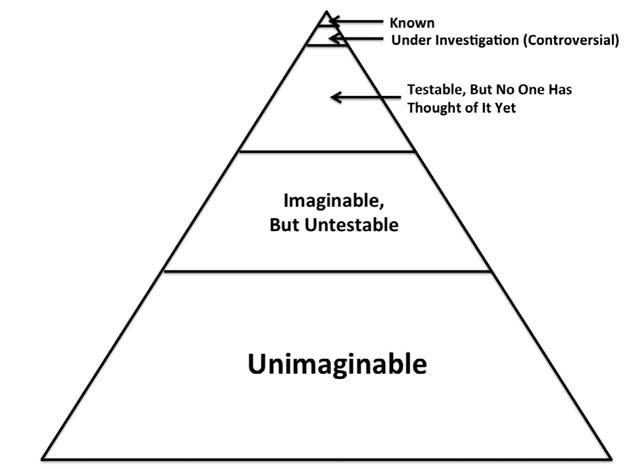
" end quote
Quote from tim on January 9, 2020, 2:49 pm@hillcountry
No worries mate, yep seafood is important.
When people talk about omega 3 ratios but they don't differentiate between linolenic acid and DHA that is very problematic. I think optimally we should obtain DHA in the diet from eggs and seafood and try to minimize other PUFAs. Flax seed oil is something to avoid, we convert little linolenic acid to longer chain PUFAs.
No worries mate, yep seafood is important.
When people talk about omega 3 ratios but they don't differentiate between linolenic acid and DHA that is very problematic. I think optimally we should obtain DHA in the diet from eggs and seafood and try to minimize other PUFAs. Flax seed oil is something to avoid, we convert little linolenic acid to longer chain PUFAs.
Quote from lil chick on January 10, 2020, 7:27 amA day off raw milk and I feel the effects in my ligaments. I need to stop stopping raw milk lol.
The yeast I bought has additives, so I saved some dough and I'm going to try to start each new batch with the last batch. I read online that involved an extra rise in which you just add some flour and water to the piece of dough you saved to activate it.
I might stop chicken keeping.
A day off raw milk and I feel the effects in my ligaments. I need to stop stopping raw milk lol.
The yeast I bought has additives, so I saved some dough and I'm going to try to start each new batch with the last batch. I read online that involved an extra rise in which you just add some flour and water to the piece of dough you saved to activate it.
I might stop chicken keeping.
Quote from lil chick on January 10, 2020, 11:55 am@hillcountry, regarding fats, I think animal fats are where it's at. Works for the animals. And juices probably have b-vities. Fats and juices-- we can't fear VA so much that we throw the baby out with the bath water. I think because we don't have another baby. Sometimes there is no good second answer. But I do lean pretty hard on coconut oil... of all the veg fats...
@hillcountry, regarding fats, I think animal fats are where it's at. Works for the animals. And juices probably have b-vities. Fats and juices-- we can't fear VA so much that we throw the baby out with the bath water. I think because we don't have another baby. Sometimes there is no good second answer. But I do lean pretty hard on coconut oil... of all the veg fats...
Quote from tim on January 10, 2020, 6:11 pmQuote from lil chick on January 10, 2020, 7:27 amA day off raw milk and I feel the effects in my ligaments. I need to stop stopping raw milk lol.
The yeast I bought has additives, so I saved some dough and I'm going to try to start each new batch with the last batch. I read online that involved an extra rise in which you just add some flour and water to the piece of dough you saved to activate it.
I might stop chicken keeping.
Do you get relief from joint pain by drinking raw milk?
Can you not just sell eggs from your gate or barter them with other food producers? I personally think you will regret stopping chicken keeping if it is all to do with VA. I now have about 1 egg per day on average, I feel they are very healthy in moderation. The yolks have so many beneficial nutrients and are a primary source of choline in the diet.
Quote from lil chick on January 10, 2020, 7:27 amA day off raw milk and I feel the effects in my ligaments. I need to stop stopping raw milk lol.
The yeast I bought has additives, so I saved some dough and I'm going to try to start each new batch with the last batch. I read online that involved an extra rise in which you just add some flour and water to the piece of dough you saved to activate it.
I might stop chicken keeping.
Do you get relief from joint pain by drinking raw milk?
Can you not just sell eggs from your gate or barter them with other food producers? I personally think you will regret stopping chicken keeping if it is all to do with VA. I now have about 1 egg per day on average, I feel they are very healthy in moderation. The yolks have so many beneficial nutrients and are a primary source of choline in the diet.